Welcome to the Spatial Omics Galaxy
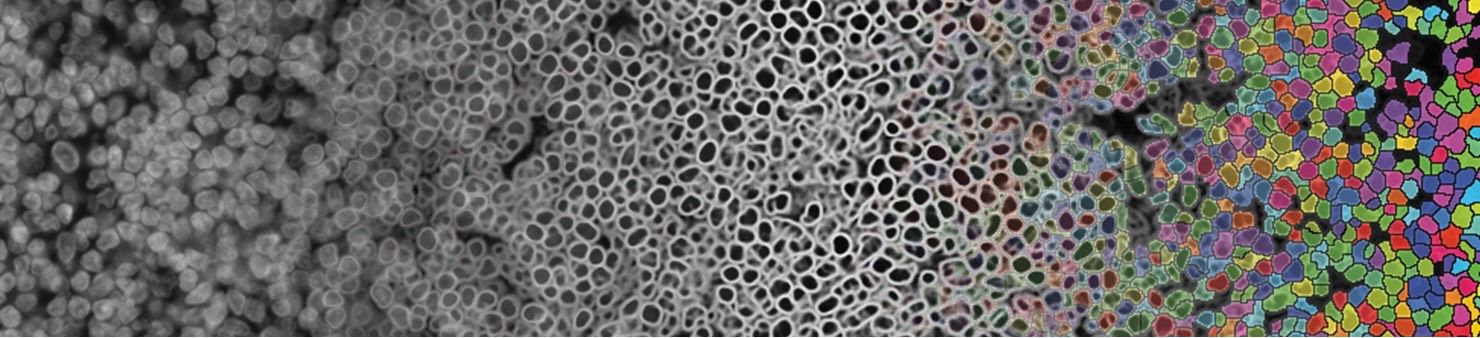
The Spatial Omics Galaxy is a hub for all tools related to the analysis of highly multiplexed image-based and sequenced-based spatial omics data. This is a combined effort by the Spatial2Galaxy project and the Goecks Laboratory members. We welcome any suggestions or requests for making tools related to Spatial Omics analysis available on this Galaxy instance. We also welcome contributions to the development of new tools, workflows, or trainings!
This server currently features the individual components of the MCMICRO pipeline, including BaSiC for illumination correction, ASHLAR for stitching and registration, Coreograph to dearray tissue microarrays (TMAs), UnMICST to create cell or nucleai probability maps, S3segmenter for nucleai and cell segmentation and MCQuant for feature quantification. More tools for image analysis outside the MCMICRO ecosystem will be added in the future.
Several spatial transcriptomics data formats and analysis tools have been integrated into Galaxy as part of the Spatial2Galaxy ELIXIR Commissioned Service.
Get started
Are you new to Galaxy, or returning after a long time, and looking for help to get started? Take a guided tour through Galaxy’s user interface.
Tools available
Here, we outline all the Galaxy tools that are relevant in the context of spatial omics data analysis.
Spatial Datatypes and Utilities
The SpatialData datatype and utilities for reading, writing, manipulating and plotting SpatialData objects.
| Tool | Description |
|---|---|
| spatialdata_io | Load common spatial omics formats into SpatialData |
| spatialdata_operation | Perform operations on SpatialData objects |
| seurat_create | Create Seurat objects from Xenium spatial data |
Segmentation and Preprocessing
Tools for segmenting and pre-processing the spatial transcriptomics data into SpatialData objects.
| Tool | Description |
|---|---|
| sopa_patchify | SOPA Patchify - Generate patches for cell segmentation |
| sopa_segmentation | SOPA Segmentation - Perform cell segmentation on patches |
| sopa_resolve | SOPA Resolve - Patch conflicts in segmented data |
| sopa_aggregate | SOPA Aggregate - Transcripts and/or channel intensities per cell |
| sopa_report | SOPA Report - Generate HTML quality control report |
| vpt_segment | Vizgen VPT - Segment cells and refine MERSCOPE experiments |
| vpt_extract | Vizgen VPT - Extract image patches from the mosaic image at the specified coordinates and size |
| spapros_selection | Selection of marker genes with spapros |
| spapros_evaluation | Evaluation of marker genes with spapros |
Spatial Downstream Analysis
Tools for spatial transcriptomics downstream analysis:
| Tool | Description |
|---|---|
| squidpy_spatial | Analyze and visualize spatial multi-omics data with Squidpy |
| spacexr_rctd | Robust Cell Type Decomposition, or RCTD, is a statistical method for learning cell types from spatial transcriptomics data |
| spacexr_cside | Cell type-Specific Inference of Differential Expression, or CSIDE, is part of the spacexr R package for learning cell type-specific differential expression from spatial transcriptomics data |
| liana_methods | Liana ligand_receptor inference and local bivariate spatial metrics for single-cell or spatial data |
| liana_misty | Liana MISTy learn spatial relationships with multi-view modelling |
| liana_multi | Liana multi-sample and multi-condition analysis |
| liana_resource | Liana Resource prior knowledge and ligand-receptor resources |
| liana_utils | LIANA utility functions for data transformation and preprocessing |
Cell Annotation & Feature Selection
Tools for marker gene identification and cell-type annotation:
| Tool | Description |
|---|---|
| cosg | COSG is a cosine similarity-based method for more accurate and scalable marker gene identification |
| celltypist | CellTypist is an automated cell type annotation tool |
Plotting and Visualization
| Tool | Description |
|---|---|
| spatialdata_plot | Rich static plotting from SpatialData objects |
| seurat_plot | Visualize spatial clusters and features from Seurat objects |
| bellavista_prepare | Prepare large images for bellavista spatial visualizer |
| interactive_tool_bellavista | Interactive visualization for imaging-based spatial transcriptomics |
| squidpy_scatter | Create spatial scatterplot with Squidpy |
| interactive_tool_cellxgene_vip | Interactive CELLxGENE VIP visualization for scRNA-seq, spatial transcriptomics, and multiome data |
| interactive_tool_napari | Interactive exploration and annotation of spatial omics data with napari |
| vitessce_spatial | Vitessce Visual Integration Tool for the Exploration of Spatial Single-Cell Experiments |
| liana_plot | Liana Plot visualize ligand-receptor interactions |
MCMICRO core tools
All of the Galaxy tools for MCMICRO have been developed by the Goecks lab at the Oregon Health and Science University Computational Biology.
| Tool | Description | Reference |
|---|---|---|
| basic_illumination | BaSiC shading correction for use with Ashlar | Peng et al. 2017 |
| ashlar | ASHLAR: Alignment by Simultaneous Harmonization of Layer/Adjacency Registration | Muhlich et al. 2021 |
| coreograph | Dearray of Tissue Microarrays | Coreograph Github |
| unmicst | UnMICST - Universal Models for Identifying Cells and Segmenting Tissue | UnMICST info |
| s3segmenter | S3segmenter: A Matlab-based set of functions that generates single cell (nuclei and cytoplasm) label masks | S3Segmenter github |
| quantification | MCQuant: Single cell quantification | MCQUant github |
Workflows available
The end-to-end spatial transcriptomics workflow that supports both image-based and sequence-based protocols: Spatial Transcriptomics Analysis in Galaxy
Two workflows are currently available to process your samples using the MCMICRO Galaxy pipeline:
MCMICRO Tissue Microarray Workflow
MCMICRO Whole Slide Tissue Workflow
Contributors
- Florian Wünnemann
- Denis Schapiro
- Bjoern Gruening
- Jeremy Goecks
- Cameron Watson
- Allison Creason
- Amirhossein Naghsh Nilchi
- Khaled Jumah
- Nicola Soranzo
- Pavankumar Videm
Spatial2Galaxy Partners
| Partners | Description | People involved |
|---|---|---|
| Erasmus Medical Center | Implementation and validation of ST toolset | Andrew Stubbs, Myrthe van Baardwijk |
| Berlin Institute of Health at Charité | Catalogue ST toolset and use cases | Naveed Ishaque |
| University of Bradford | Develop Spatial2Galaxy tutorial suite and deliver training | Krzysztof Poterlowicz, Khaled Jum’ah |
| University of Freiburg | Development of Spatial2Galaxy portal, tools and workflows | Björn Grüning, Amirhossein Naghsh Nilchi, Pavankumar Videm |
| Earlham Institute | Develop Galaxy Demonstrator user case | Irene Papatheodorou, Nicola Soranzo |
Our Data Policy
| Registered Users | Unregistered Users | FTP Data | GDPR Compliance |
|---|---|---|---|
| For all different storage options, for detailed explanations of data retention policies, and ways how to increase your quota please refer to our dedicated storage site. | Processed data will only be accessible during one browser session, using a cookie to identify your data. This cookie is not used for any other purposes (e.g. tracking or analytics). If UseGalaxy.eu service is not accessed for 90 days, those datasets will be permanently deleted. | Any user data uploaded to our FTP server should be imported into Galaxy as soon as possible. Data left in FTP folders for more than 3 months, will be deleted. | The Galaxy service complies with the EU General Data Protection Regulation (GDPR). You can read more about this on our Terms and Conditions. |