

Galaxy is an open-source platform for FAIR data analysis that enables users to:
- use tools from various domains (that can be plugged into workflows) through its graphical web interface.
- run code in interactive environments (RStudio, Jupyter…) along with other tools or workflows.
- manage data by sharing and publishing results, workflows, and visualizations.
- ensure reproducibility by capturing the necessary information to repeat and understand data analyses.
The Galaxy Community is actively involved in helping the ecosystem improve and sharing scientific discoveries.
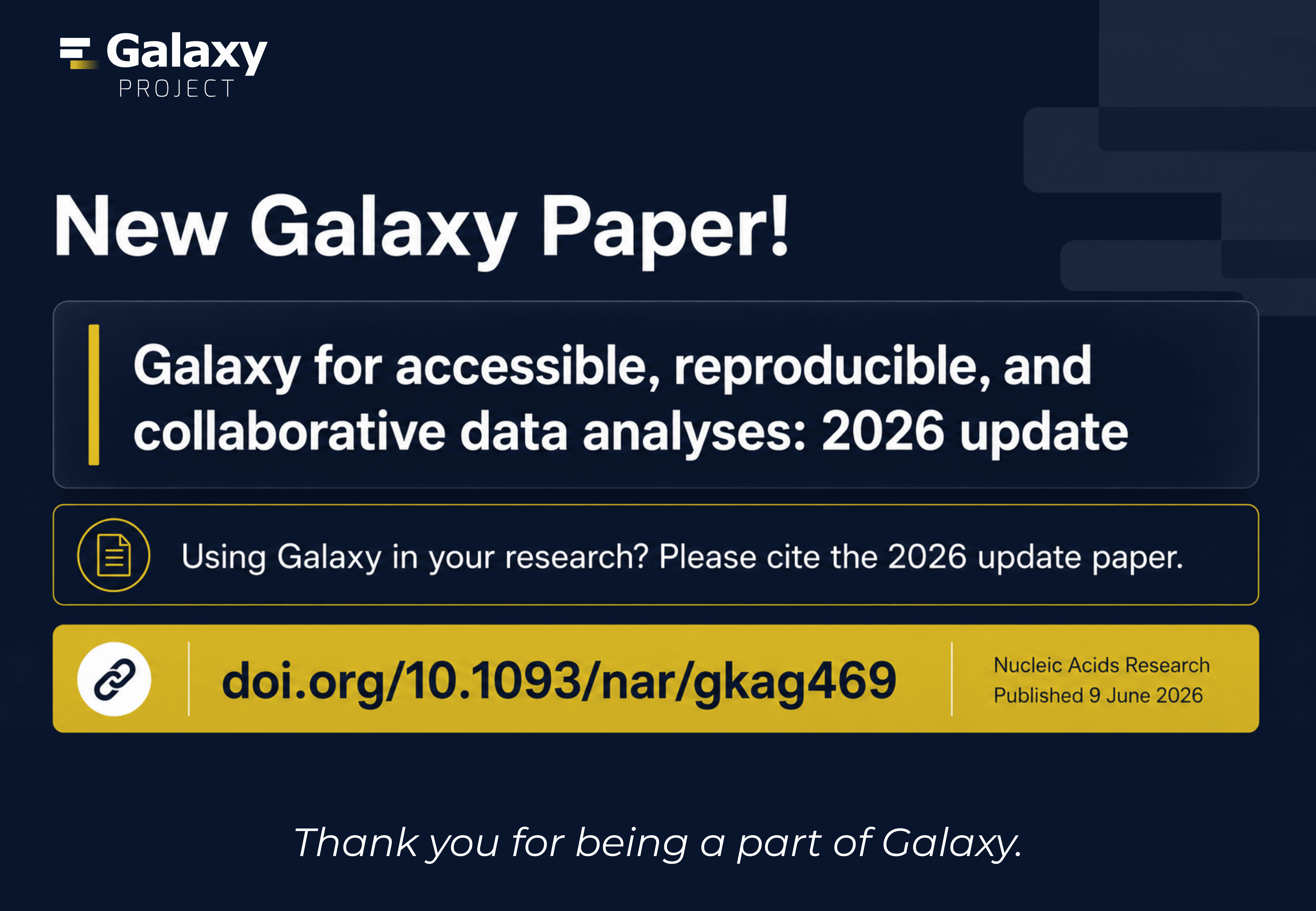
- BioFAIR Data to Discovery Single-Cell Training and CoFest Highlights from a single-cell event in the UK and future opportunities to get involved with SPOC and BioFAIR.
- microGalaxy Hackathon for Tool Development Join the microGalaxy community on October 14th to update outdated metagenomics tools in the IUC repository!
- New Publication "Bioimage management and analysis in Galaxy: Tools, workflows, training, and community practices" The Image Analysis in Galaxy community is happy to share the first dedicated publication on bioimage data management, analysis, and community practices in Galaxy
- Last Few Spots left - Galaxy Tool Development Workshop, Registration Closes 14 September Only a handful of spots remain for the 2nd Galaxy Tool Development Workshop in Freiburg (7-9 October 2026). Registration closes on 14 September, and remote participation is available.
- Galaxy at the International IUSSI Congress 2026 — Exploring termite gut microbiome recovery At IUSSI 2026 in Freiburg, Mina Hojat Ansari presented how reproducible, multi-layer metagenomic analysis in Galaxy helps investigate termite gut microbiome recovery after molting.
- Galaxy Beyond Basics: Mastering Workflows, Automation, and Scalability Oct 12 - Oct 16 · Paris, FranceJoin us for an **intensive, week-long, in-person training** designed to elevate your Galaxy expertise to new heights
- Introduction to the Data Analysis Platform Galaxy (in German) Dec 2 · Freiburg, Germany
- Workshop on high-throughput sequencing data analysis with Galaxy Mar 1 - Mar 5 · Freiburg im Breisgau, GermanyThis course introduces scientists to the data analysis platform Galaxy
- Workflow4Experimenters 2027 Apr 5 - Apr 30 · Rennes, FranceAnalyze your data with Galaxy and the Workflow4Metabolomics infrastructure! During this one-week-long on-site course (preceded by half-a-week of webinars), you will learn how to use the W4M-promoted Galaxy tools for metabolomics, and analyze your own LC-MS, GC-MS or NMR data through tutoring sessions.
- 2027 Galaxy Community Conference (GCC2027) Jun 26 - Jul 1 · Longueuil (Montréal area), Québec, CanadaThe yearly conference of the Galaxy community, where researchers, developers, and educators from around the world meet to share science, learn, and shape the future of open data analysis.
The French Galaxy server
The French Galaxy server UseGalaxy.fr is maintained by IFB NNCR Cluster Task force. Please check our Terms of Use and data retention policy before using the server. We offer thousands of tools, increased quota on temporary basis, and compute infrastructure for trainers through Training Infrastructure as a Service (TIaaS).
The following regional platforms, members of IFB, are involved in the maintenance and development of UseGalaxy.fr:

Training
If you are organising a training session, you can book computing resources using the TIaaS system

GalaxyCat
Can’t find a tool on usegalaxy.fr? Why not search on the IFB Galaxy Catalog ?

Communities: domain-centric Galaxy subdomains
Microbiology
Whether you’re working with microbiome samples or bacterial isolates, long or short reads, shotgun or 16S sequencing, genomics, transcriptomics, proteomics, metabolomics, or integrative multi-omics analysis—this is the place for you!
Single-cell
Access Single Cell Omics analysis tutorials, tools, and workflows that let you analyse data without programming experience or private infrastructure.
Workflow4Metabolomics
Data processing, analysis and annotation for the metabolomics community.


Metabarcoding
With the following tools and pipelines: FROGS, QIIME, Mothur, Obitools, dada2, PICRUSt.



Biodiversity genomics
Tools, workflows and tutorials produced by the Galaxy Ecology community, focusing on biodiversity genomics.
Imaging
Explore tools for image processing, segmentation, quantification, and analysis, from raw data to advanced visualization and machine learning applications.
B-BEST
Bioproductions lab of the France 2030 B-BEST programme: biomass, biotechnologies, and sustainable technologies for chemistry and fuels.

Biofoundries
Workflows of the Paris Biofoundry, a distributed biology platform in the Île-de-France region.

SynBioCAD
Workflow environment to design and build different metabolic routes for the production of a compound of interest.
