
Projects at BioHackathon Europe 2026
Three BioHackathon Europe 2026 projects workflow portability, collaborative microbiome knowledge graphs, and AI model repository integration and model execution.
On this page
At BioHackathon Europe 2026 (November 9-13, 2026, Campus Belloch, Spain), contributors from across the research software and life-science communities worked together on three projects. Their work ranged from porting workflows from ecosystem to another, laying the foundations for a collaborative microbiome knowledge graph and integrating AI resources for model execution.
Project 31: Nextflow to Galaxy Workflow Portability and FAIRness via Modular LLM Agent Skills
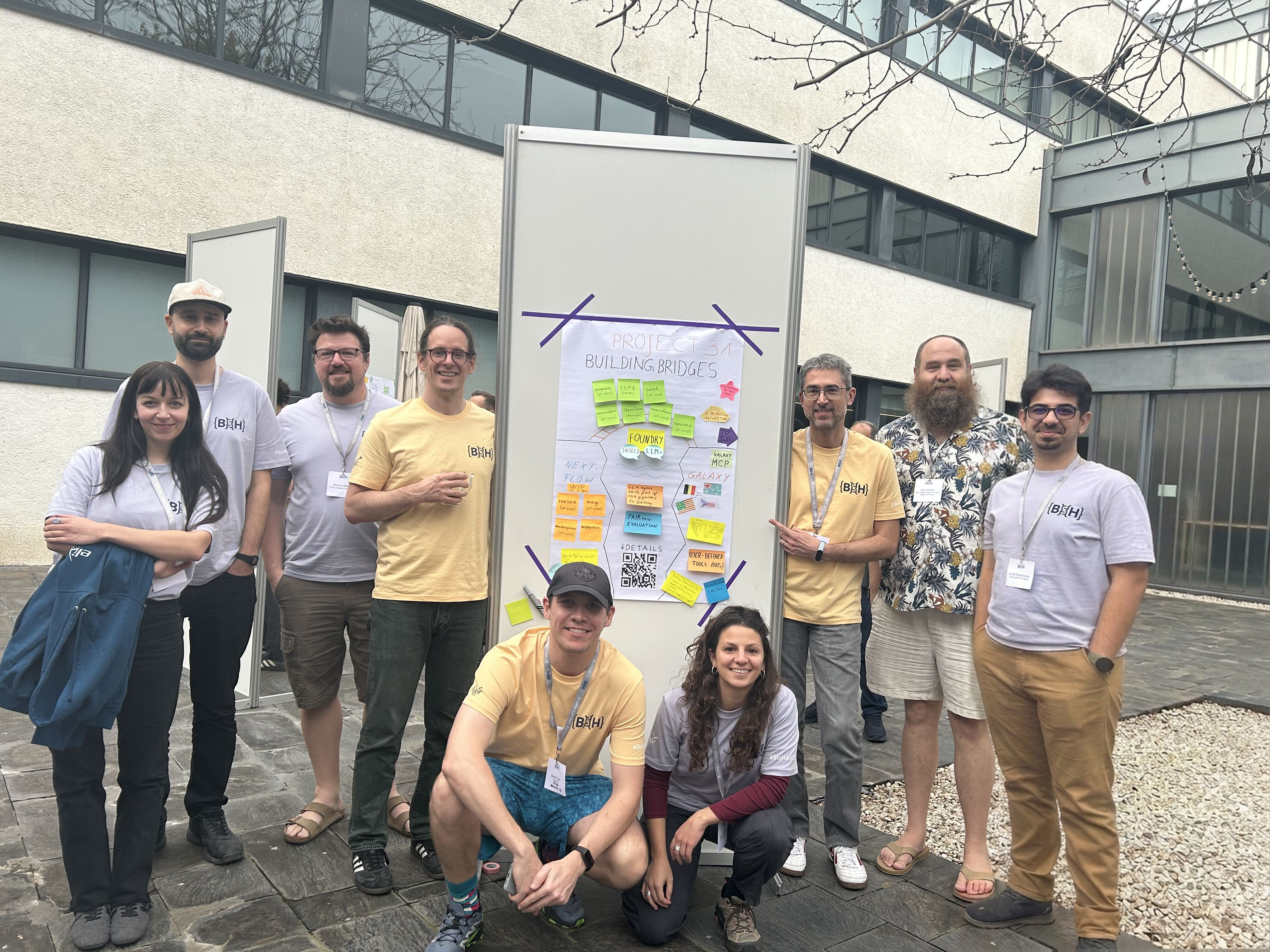
The Galaxy Workflow Foundry is a knowledge base and a set of modular LLM agent skills for converting workflows from other systems, such as Nextflow pipelines, papers, and CWL workflows, into Galaxy workflows that are checked with Galaxy’s own validation and testing tools.
During the BioHackathon, the team used the Foundry to convert pipelines, fully or in part, including nf-core/demo, bamtofastq, rnaseq, sarek, scrnaseq, mag, atacseq, ampliseq, nanoseq, and oncoanalyser, as well as pipelines from outside nf-core such as OceanOmics-amplicon-nf and CSP2. The team compared the resulting Galaxy workflows with real Nextflow runs. The runs were shared openly in IWC Lab.
Problems found along the way were fed back as issues and fixes to the Foundry and to Galaxy’s workflow tooling, many of them from first-time contributors. A second track reviewed how FAIR existing IWC workflows are, as a basis for a FAIR review checklist.
Participants: Nicola Soranzo, Martin Čech, Marius van den Beek, John Chilton, Dannon Baker, Arash Kadkhodaei, Michael R. Crusoe, Franziska Nicolaus, Pavel Abramau, Maria Tsontaki, Emmi Rehn, Rand Zoabi, Shubh Sharma, Ivy Chen, Egor Fedosov, Anastasia Ermolova, Anna Syme, Halimat Chisom Atanda, Adam Bennett, Gareth Price, Jaskirat Singh, Ziad Al Bkhetan, and George He.
Project 16: MiCoKnowGraph—Building Common Knowledge for a Collaborative Microbiome Knowledge Graph
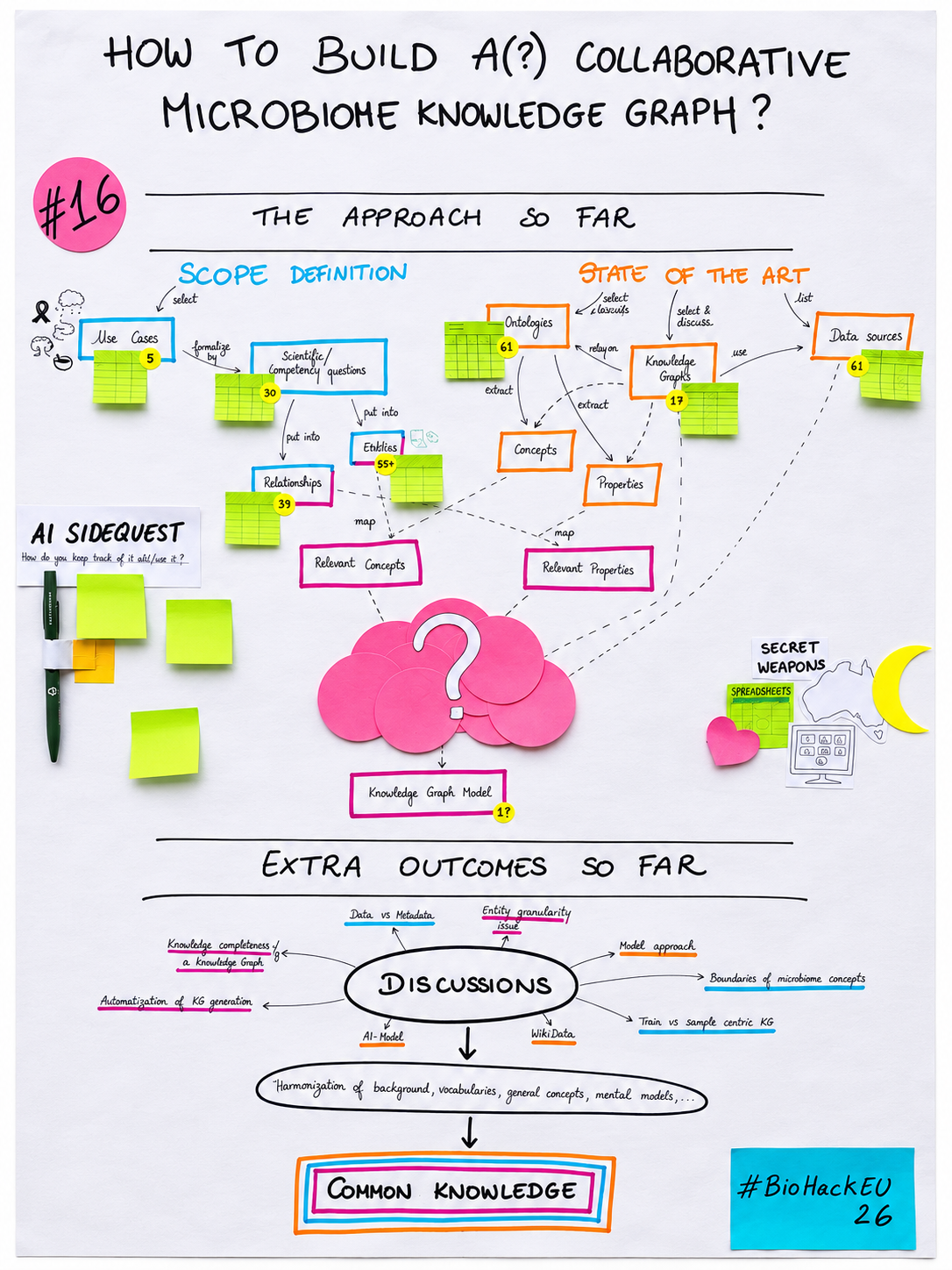
How can we build a collaborative microbiome knowledge graph?
During BioHackathon Europe 2026, the MiCoKnowGraph team brought together researchers from different backgrounds and areas of expertise to address this challenge. The aim was to establish a common understanding of microbiome knowledge and explore how existing standards and resources could support a collaborative knowledge graph across different research domains.
Throughout the five-day hackathon, the team worked on defining scientific use cases and competency questions to identify what the knowledge graph should be able to answer and which biological entities and relationships would be needed. In parallel, the team identified, collected, and reviewed existing ontologies, knowledge graphs, and data sources, examining relevant concepts and properties and their suitability for the different research questions.
These activities also led to discussions about harmonizing terminology, connecting knowledge across domains, representing complex biological observations, and choosing suitable graph-modelling approaches. By bringing together different scientific perspectives, the team made progress toward a shared vocabulary and a common understanding of the requirements for a collaborative microbiome knowledge graph.
The hackathon provided a foundation for continued collaboration, supported by the collected resources, documented use cases, and ongoing discussions. The team has also started preparing a collaborative manuscript for submission to BioHackrXiv to document the project’s approach and findings. Building on this initial work, the next steps will focus on further harmonizing concepts and relationships and developing and evaluating a common knowledge graph model.
On-site participants: Bérénice Batut, Iphigénie Gonnet, Giuseppe Defazio, Sebastian Jünemann, Mina Hojat Ansari, and Brieuc Quemeneur.
Additional participants joined remotely, including members of the Australian BioHackathon outpost.
Project 13: ELIXIR AI Ecosystem Integration: Bridging DOME, BioAIrepo and Galaxy
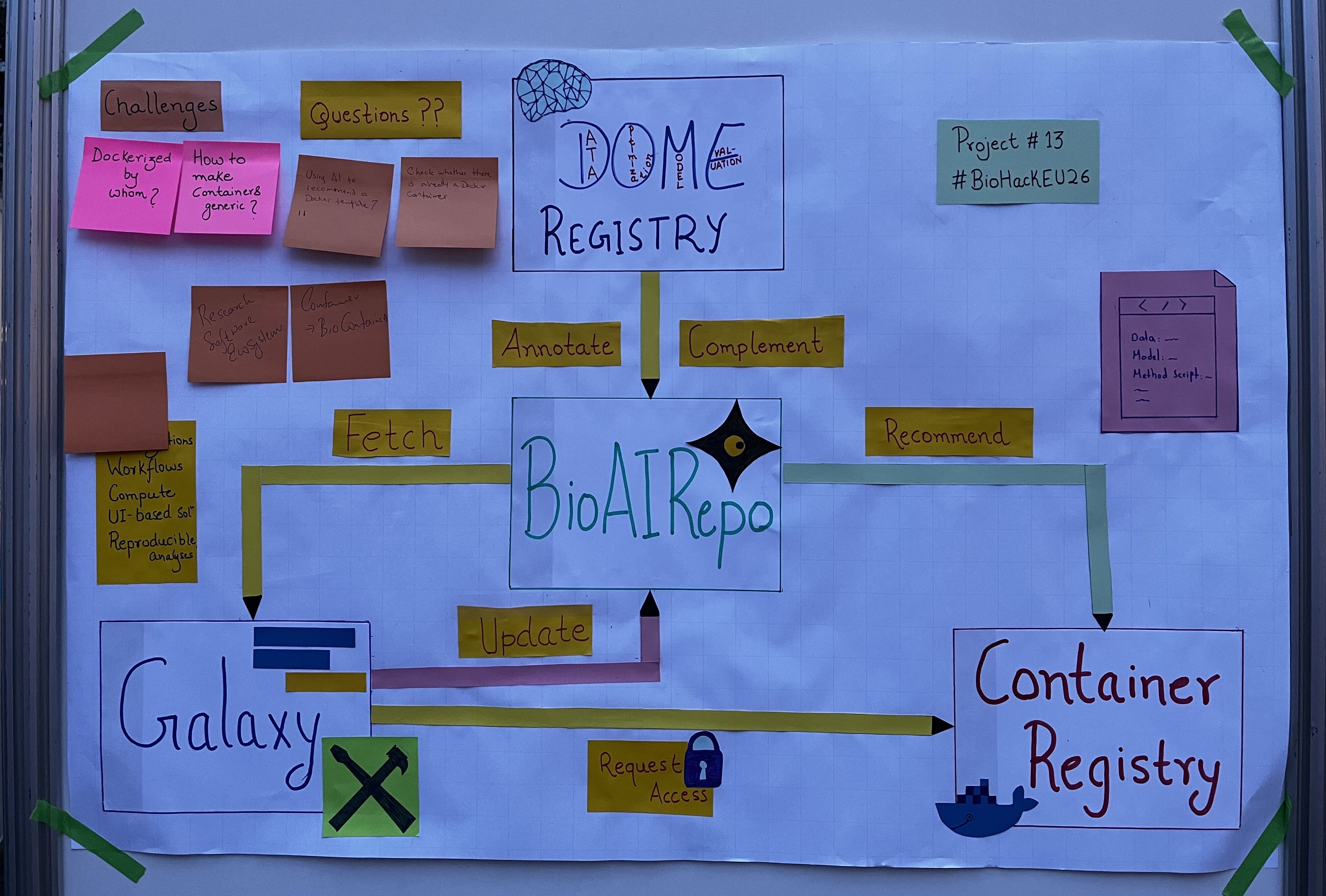
Machine learning is transforming life-science research, but discovering a model does not necessarily make it easy to reproduce or run. The BioHackathon project set out to close this gap by connecting complementary parts of the ELIXIR AI ecosystem: the DOME Registry for transparent method reporting, BioAIrepo for depositing models and associated data, and Galaxy for accessible and reproducible execution.
BioAIrepo is an AI model repository implemented as a collection within EMBL-EBI’s BioStudies database. It allows life scientists to share model metadata, weights and other files, as well as links to the datasets used to build, test and validate models. Project 13 explored how these deposited assets could become actionable: instead of ending the journey at a catalogue record, a researcher should be able to bring the asset into Galaxy and run it through a standard interface.
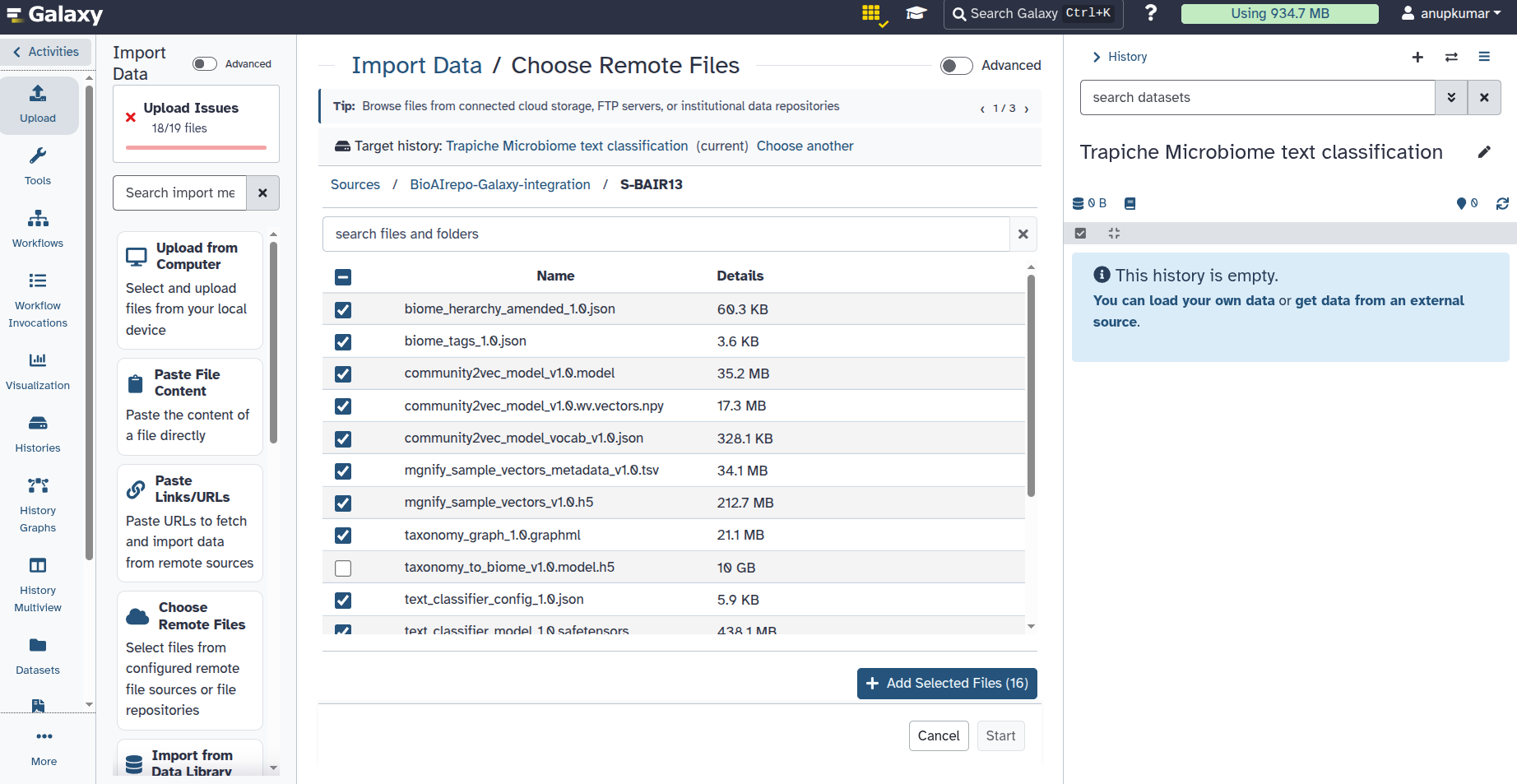
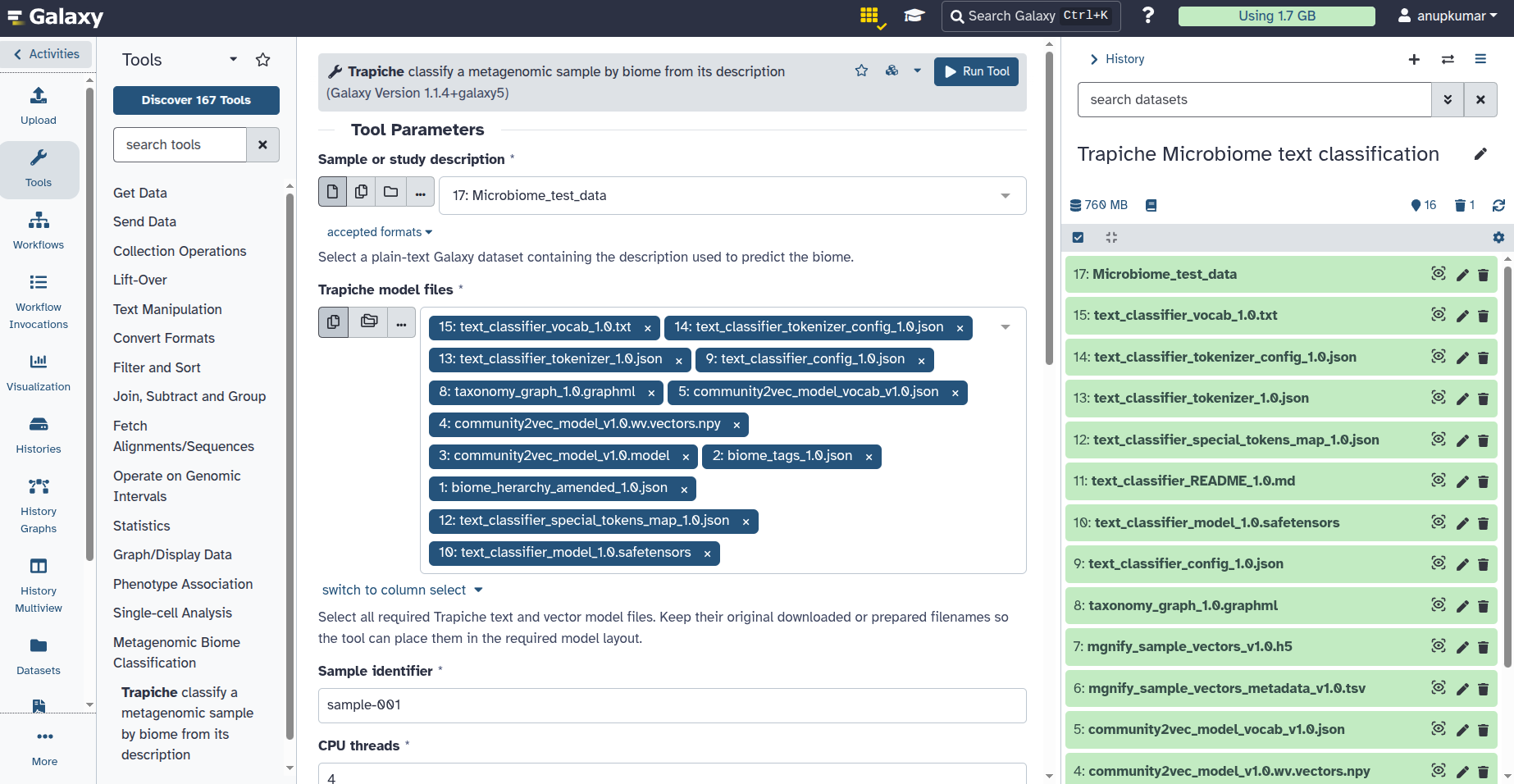
During the BioHackathon, the team developed a BioAIrepo file source plugin for Galaxy. This proof of concept lets Galaxy connect to BioAIrepo and access its resources directly, providing a reusable path from model discovery to analysis. It also contributes to the project’s broader goals of improving links among DOME, and BioAIrepo, and of producing clearer guidance for model submission, discovery and execution.
The team used BioAIrepo record S-BAIR13, Trapiche—Multi-source biome classification from text and taxonomy, as a practical demonstrator. Trapiche is an open-source tool for classifying the biome of origin of metagenomic studies and samples. It combines predictions derived from project or sample descriptions with taxonomic community profiles: a fine-tuned language model can infer candidate biome labels from text, while a taxonomy-vectorization model uses taxonomic profiles to predict deeper biome lineages. Bringing these complementary signals together improves the context available for biome classification.
To make the text-classification component executable and portable, the project produced container images:
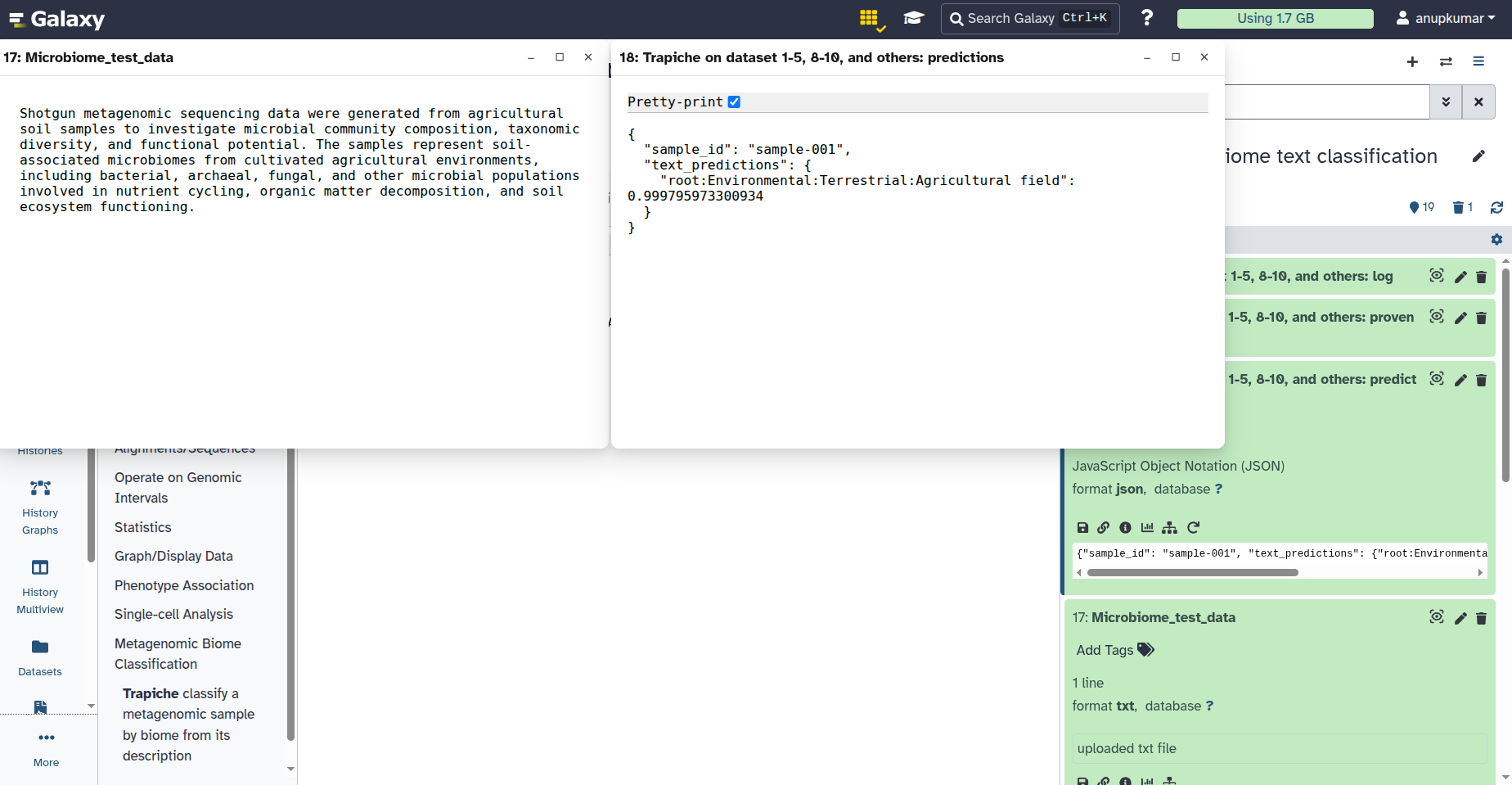
A Galaxy tool for making predictions was also created. Together, the BioAIrepo file source, containers and Galaxy tool demonstrate an end-to-end route in which a deposited model can be found, retrieved and executed in a reproducible analysis environment. This moves the ELIXIR AI ecosystem toward the project’s longer-term goal: cross-linked AI resources that are not only findable and documented, but readily reusable by the scientific community.
Integration of BioAIrepo with Galaxy
Tool for making text-based biome predictions in Galaxy
Tool outputs
Participants: Omar Attafi (UNIPD-it), Anup Kumar (UFR), Mauricio Martinez (EMBL-EBI), and Jhoan Serrano (EMBL-EBI).
Acknowledgements
We would like to thank ELIXIR, BioHackathon Europe 2026 organizers, sponsors, and participants for their support and contributions to these projects. The collaborative efforts of the Galaxy community and the broader life-science research community continue to drive innovation and reproducibility in computational biology.