
Galaxy (UFR) joins the EOSC-MESH Kickoff in Ghent, Belgium
EOSC-MESH kickoff meeting in Ghent: Galaxy helps extend the European Open Science Cloud!
On this page
EOSC-MESH
A new EU-funded project under the HORIZON-INFRA programme, EOSC-MESH, was officially kicked off on September 24th-25th in conjunction with the EGI 2026 conference in Ghent, Belgium. The project is coordinated by the EGI Foundation, which manages the entire consortium.
Europe faces major fragmentation in accessing, sharing, and reusing research data and services across disciplines and borders. Over the next three years, EOSC-MESH will address these challenges and expand EOSC capacity and capabilities by establishing seven federating Nodes, interoperable with the EOSC EU Node: Biobanking and Biomolecular Resources (BBMRI), ENVRI (Environmental RIs), SSHOC (Social Sciences and Humanities), Scholarly Communications (OpenAIRE and OPERAS), High Energy Physics (CERN), and e-Infrastructures (EGI Federation and EUDAT CDI). EOSC-MESH aims at advancing EOSC technically and organisationally, while providing tangible benefits to researchers, accelerating open and collaborative science in Europe.
The federating Nodes will provide 25 Federating Capabilities offering Core, Generic and Thematic functionalities, and additional resources to EOSC including 2600+ tools and services, 1700+ datasets and the world’s largest biobank data repository, 80 workflows, and 5000+ other research artefacts. The project supports 7 cross-node, international use cases from Environmental Science, Health, Social Science and Humanities, and Multidisciplinary Science.
Contributions to EOSC-MESH
Galaxy (UFR) will lead Work Package 5 (WP5), for Delivery and Technical Support of Generic and Thematic EOSC Federating Capabilities.
The WP5 aims to:
-
Maintain and enhance a suite of generic federated capabilities for secure, interoperable and scalable data use, reuse and exploitation by EOSC end users.
-
Provide technical support and integration pathways for thematic capabilities and communities to adopt and integrate those generic capabilities.
-
Support delivery and onboarding of community-specific federated services - particularly Environmental Sciences and Social Sciences - through the EOSC-MESH Nodes.
-
Accelerate maturity, sovereignty and sustainability of EOSC by promoting the uptake of federated capabilities.
Running for the full 36 months of the project, WP5 brings together 12 partners (UFR, BBMRI, CERN, CESNET, DESY, UNITN, UPV, CLARIN, DARIAH, EPOS, INGV and UvA) and 151 person-months of effort. It operates 12 of the 25 capabilities in the EOSC-MESH Hub catalogue across two tasks: T5.1 Generic Federating Capabilities, led by UFR, and T5.2 Thematic Federating Capabilities, led by CLARIN and DARIAH.
The eight generic capabilities cover the whole analysis lifecycle: running analyses (Galaxy, REANA, Jupyter Notebooks and the Infrastructure Manager), moving data and software (FTS and CernVM-FS), tracking provenance (yProv), and processing sensitive data in secure, certified environments.
Three of the seven use cases, DataTerra (UC4), EMSO (UC5) and Social Sciences and Humanities (UC7), will use Galaxy as a generic capability. For these, Galaxy will add domain-specific tools and curated workflows for Environmental Sciences and for the Social Sciences and Humanities, aligned with community data access policies. The SSH Marketplace, a discovery portal with more than 5,750 resources, will also gain direct analysis execution through Galaxy, Notebooks and REANA, so researchers can go straight from finding a tool or dataset to running it.
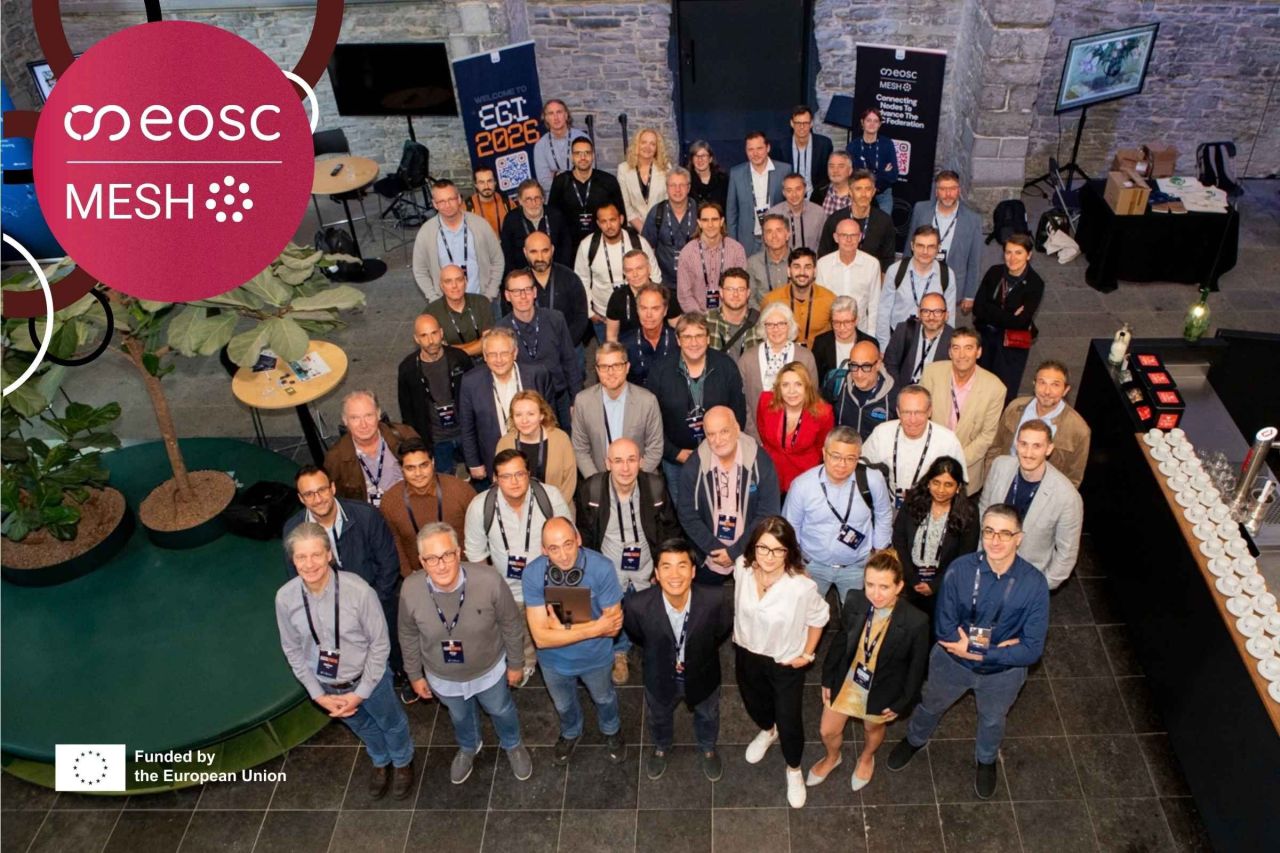
Image credit: EOSC-MESH / EGI Foundation
We would like to thank the EGI Foundation for coordinating the consortium and hosting a well-organised kickoff in Ghent, all EOSC-MESH partners for the open and productive discussions, and our Project Managers for their guidance and support. We look forward to the next three years of working together.