
Using Claude AI for Literature Searches
LLMs for literature search produce 'interesting' results: It is almost useful
On this page
Using Claude AI for Literature Searches
Introduction
Finding all relevant literature for a research project is crucial but challenging. While AI assistants like Claude and ChatGPT promise to streamline this process, how effective are they really? I conducted a systematic experiment using multiple AI-assisted approaches to survey RNA-seq studies on Candida auris, a dangerous multidrug-resistant fungal pathogen. The results revealed both the power and limitations of AI-assisted literature searches.
The Workflow: A Multi-Strategy Approach
Step 1: Initial Claude Survey
I started by asking Claude to perform a comprehensive literature survey of RNA-seq studies on Candida auris published since 2020. Claude conducted searches across:
- PubMed and PubMed Central - Standard biomedical literature databases
- Europe PMC - European alternative with different indexing
- Repository Analysis - NCBI BioProject and GEO databases
Claude identified 16 papers and provided detailed information including:
- Genome reference versions used
- Bioinformatics tools and pipelines
- Experimental designs and research questions
- Full-text extraction of methodological details
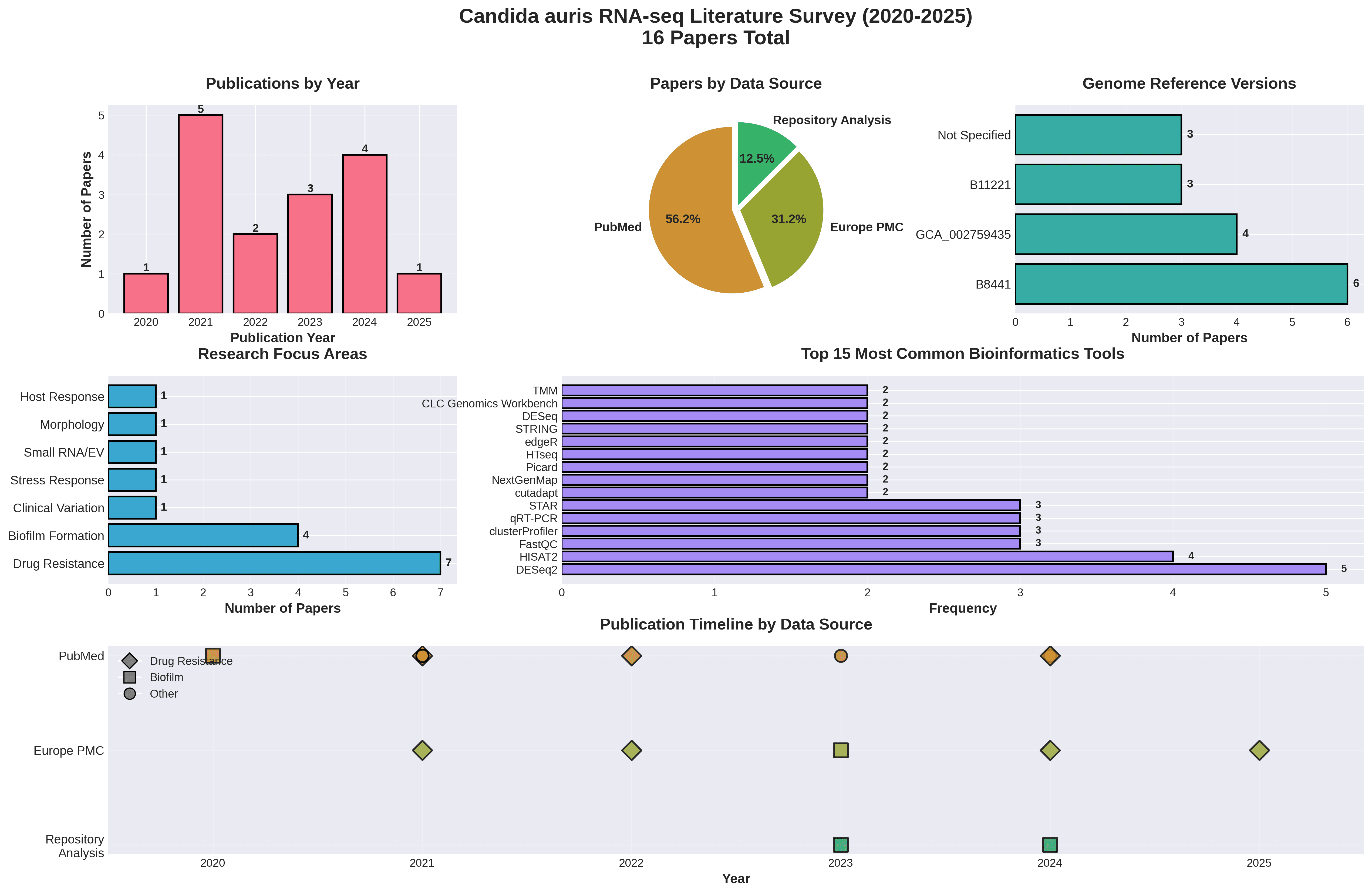 Figure 1: Claude’s initial survey revealed 16 RNA-seq studies with detailed tool usage and research focus analysis
Step 2: ChatGPT Comparison
To test whether a single AI assistant captures all relevant literature, I performed the same search using ChatGPT. Remarkably, ChatGPT found 9 different papers while searching the same databases (PubMed and Europe PMC) on the same day.
The striking finding: ZERO overlap between Claude and ChatGPT results!
Despite both AI assistants searching identical databases, they found completely different sets of papers. This revealed that:
- Search query formulation critically affects results
- Different AI systems have distinct search strategies and biases
- No single AI tool provides comprehensive coverage
- The two approaches were complementary, not redundant
Step 3: GEO Database Search
Finally, I uploaded a list of GEO accessions corresponding to C. auris (TaxID: txid498019) and asked Claude to identify all associated papers. This GEO-based search uncovered 11 studies, including 7 unique papers not found by either AI literature search.
These GEO-exclusive papers included:
- High-impact publications in Nature Microbiology and Nature Communications
- Foundational 2018 studies establishing key methodologies
- Papers where RNA-seq was a supporting technique rather than the primary focus
- Studies using novel approaches (dual-species RNA-seq, single-cell, QuantSeq)
Step 4: Combined Analysis
The final step involved merging all three search strategies and creating comprehensive visualizations and statistical analyses. Claude integrated:
- All 32 unique papers identified across the three approaches
- Temporal trends and research focus analysis
- Tool standardization and consensus pipelines
- Source overlap analysis
Key Results
The Numbers Tell a Powerful Story
| Search Strategy | Papers Found | Unique Contribution |
|---|---|---|
| Claude AI survey | 16 | 14 unique papers (43.8%) |
| ChatGPT survey | 9 | 7 unique papers (21.9%) |
| GEO database | 11 | 7 unique papers (21.9%) |
| Combined Total | 32 | 100% more than any single method |
 Figure 2: Comprehensive overview showing papers by year, source distribution, genome usage, and research focus across all three search strategies
Critical Insights
1. Multiple AI Assistants Are Essential
The zero overlap between Claude and ChatGPT despite searching the same databases demonstrates that query formulation and search strategy matter enormously. Different AI systems:
- Use different keyword combinations
- Apply different relevance ranking algorithms
- Have distinct selection biases (Claude emphasized drug resistance; ChatGPT was more diverse)
- Access full-text differently (affecting verification and detail extraction)
2. Repository Searches Complement Literature Searches
The GEO database search found 22% of total unique papers, including:
- Papers where RNA-seq was secondary methodology
- High-impact studies that don’t emphasize sequencing in titles/abstracts
- Studies with public data deposition requirements
- Foundational early work establishing methodologies
3. Combined Approach Doubles Coverage
Using all three strategies provided 100% more papers than any single approach:
- Single best method (Claude): 16 papers
- Combined approach: 32 papers
- Coverage improvement: +100%
This wasn’t due to redundancy - the searches were remarkably complementary with minimal overlap.
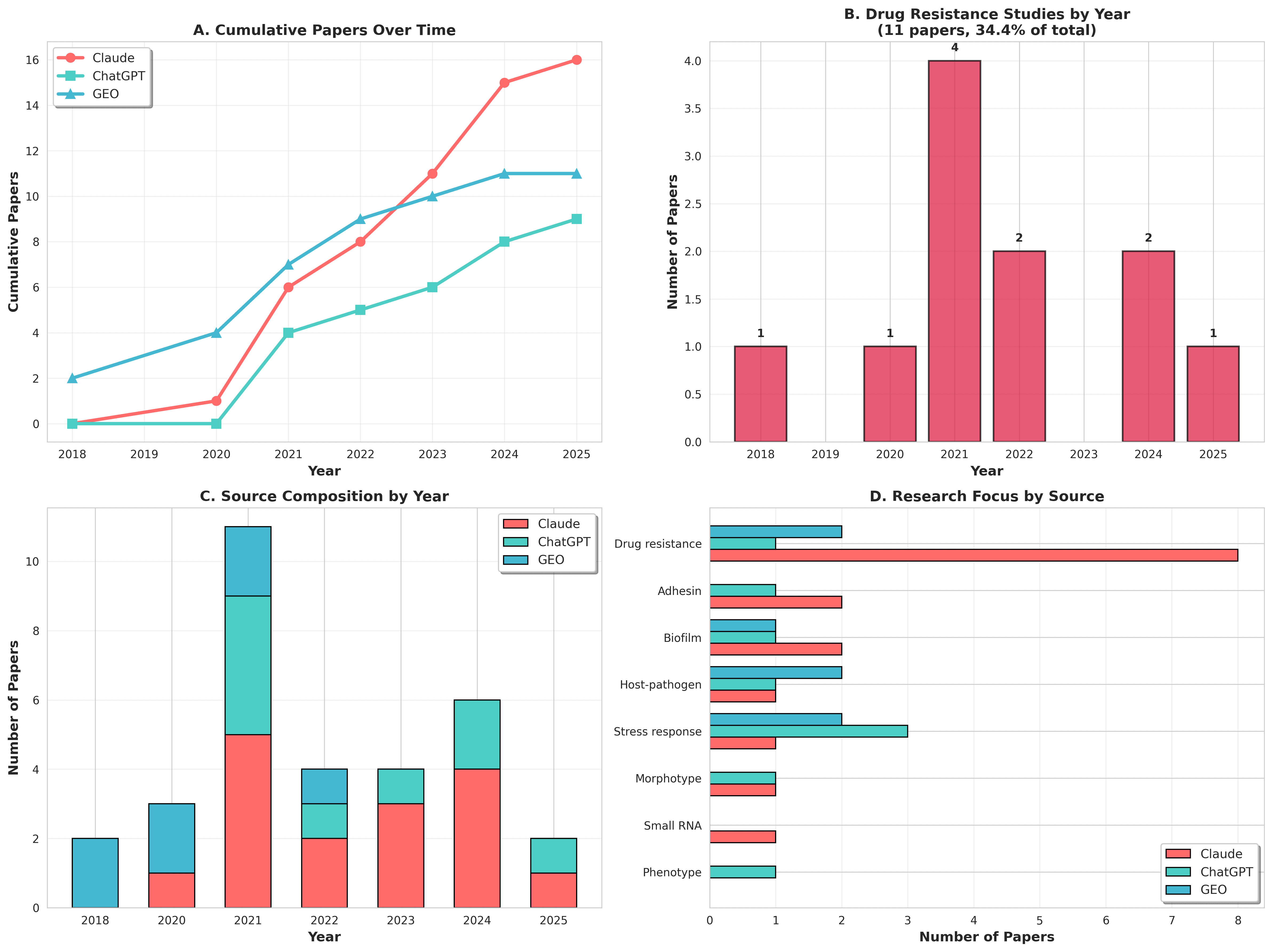 Figure 3: Detailed analysis showing temporal trends, drug resistance studies over time, source composition, and research focus distribution
Complete Literature Table
The table below shows all 32 unique papers identified through the three search strategies:
| PubMed ID | Year | Found By | GEO/BioProject | Genome | Type of Study |
|---|---|---|---|---|---|
| 29997121 | 2018 | GEO | PRJNA477447 | B8441 | De novo transcriptome: biofilm development |
| 30559369 | 2018 | GEO | PRJNA445471 | B8441/B11221 | Multidrug resistance |
| 32581078 | 2020 | Claude | - | N/A | Biofilm vs. planktonic |
| 32839538 | 2020 | GEO | GSE154911 | Human hg38 | Host PBMC response (QuantSeq) |
| 33077664 | 2020 | GEO | GSE136768 | B8441 | Fluconazole resistance aneuploidy |
| 33937102 | 2021 | Claude/GEO | GSE165762 | B11221 | Clinical isolate transcriptome signatures |
| 33983315 | 2021 | ChatGPT | - | B8441 | Farnesol exposure |
| 33995473 | 2021 | ChatGPT | - | B8441 | Transcriptome signatures |
| 34083769 | 2021 | GEO | GSE171261 | B8441 | LncRNA DINOR stress regulator |
| 34354695 | 2021 | Claude | - | N/A | Drug resistance China |
| 34462177 | 2021 | ChatGPT | - | B8441 | Global stress responses |
| 34485470 | 2021 | Claude | - | GCA_002759435 | Farnesol response |
| 34630944 | 2021 | Claude | - | B8441 V2 | Caspofungin translational profiling |
| 34643421 | 2021 | GEO | GSE180093 | B8441 | Farnesol exposure |
| 34778924 | 2021 | ChatGPT | - | B8441 | Caspofungin proteomics |
| 34788438 | 2021 | Claude | - | B8441 V2 | Small RNA-seq: extracellular vesicles |
| 35142597 | 2022 | GEO | GSE179000 | B8441 + Human | Dual-species: whole blood infection |
| 35649081 | 2022 | ChatGPT | - | B8441/B11221 | Adhesin mutants |
| 35652307 | 2022 | Claude/GEO | GSE190920 | B8441 | AmB resistance |
| 35968956 | 2022 | Claude | - | B8441 | Echinocandin resistance |
| 36913408 | 2023 | Claude | - | GCA_002759435.2 | ALS4 amplification biofilm |
| 37350781 | 2023 | Claude | - | B11221 | Rough vs. smooth morphotypes |
| 37532970 | 2023 | GEO | GSE223953 | B8441 | Tyrosol exposure planktonic |
| 37548469 | 2023 | ChatGPT | - | Isolate 12 | Tyrosol exposure |
| 37769084 | 2023 | Claude | PRJNA904261 | B8441 V3 | SCF1 adhesin (Science) |
| 37925028 | 2025 | ChatGPT | - | B8441 | White-brown switching |
| 38440972 | 2024 | GEO | PRJNA792028 | B8441 | Farnesol/tyrosol biofilms |
| 38537618 | 2024 | ChatGPT | - | B8441/Isolate 12 | Farnesol/tyrosol biofilms |
| 38562758 | 2024 | Claude | PRJNA1086003 | GCA_002759435 | Adhesin redundancy (Nat Commun) |
| 38745637 | 2024 | ChatGPT | - | B8441 | Single-cell RNA-seq: immune evasion |
| 38990436 | 2024 | Claude | - | N/A | Host dermal cells ferroptosis |
| PMC11385638 | 2024 | Claude | - | B11221 | AmB microevolution |
| PMC11459930 | 2024 | Claude | - | B8441 | Pan-drug resistance |
| 40099908 | 2025 | Claude | GSE272878 | B8441 | Flucytosine resistance SNP calling |
Key observations from the table:
- B8441 genome dominance: 75% of studies use the B8441 (Clade I) reference
- Peak year 2021: 11 papers (34.4% of total)
- Source diversity: Each search strategy contributed unique papers
- High-impact publications: Includes Science and Nature Communications papers
- Methodological diversity: From de novo assembly to single-cell RNA-seq
Research Insights Gained
Beyond methodology, the comprehensive survey revealed important scientific trends:
Emerging Consensus Pipeline
- HISAT2 (62.5% of studies) - dominant aligner
- DESeq2 (68.8% of studies) - gold standard for differential expression
- B8441 reference genome (75% of studies) - standard reference
- Standard workflow: FastQC → HISAT2 → HTSeq/featureCounts → DESeq2
Research Focus
- Drug resistance (34.4%) - reflecting urgent clinical threat
- Stress responses (18.8%)
- Biofilm formation (12.5%)
- Host-pathogen interactions (12.5%)
Temporal Evolution
- 2018-2020: Foundational studies, method establishment
- 2021: Peak year with 11 papers (34.4% of total)
- 2022-2025: Specialization, advanced approaches (single-cell, pan-drug resistance)
Lessons Learned: Best Practices for AI-Assisted Literature Searches
DO:
- Use multiple AI assistants - Claude and ChatGPT together found 56% more papers than either alone
- Search multiple databases - PubMed, Europe PMC, GEO, BioProject complement each other
- Check data repositories - GEO/SRA capture papers missed by keyword searches
- Verify full-text when possible - Abstracts may miss or mischaracterize methodology
- Vary search terms - “RNA-seq” vs “transcriptome” vs “differential expression” yield different results
- Combine approaches - Literature searches + repository mining + citation tracking
DON’T:
- Rely on a single AI assistant or database
- Assume “same database” means “same results”
- Trust that one comprehensive search captures everything
- Overlook papers where your method is secondary
- Skip manual verification and deduplication
Conclusions
This experiment demonstrated that AI assistants like Claude are powerful tools for literature searches, but they have important limitations:
Strengths:
- Rapid, systematic searches across multiple databases
- Detailed information extraction from full-text articles
- Comprehensive analysis and visualization
- Reproducible search strategies
- Integration of diverse data sources
Limitations:
- No single AI tool is comprehensive
- Search strategy and query formulation critically matter
- Different systems have different biases and blind spots
- Repository searches still require manual guidance
The Bottom Line: For comprehensive literature reviews, use multiple AI assistants with different search strategies, then merge and manually curate the results. In this study, combining Claude, ChatGPT, and GEO database searches uncovered 100% more papers than the best single approach.
Reproducibility
All search strategies, data extraction methods, analysis scripts, and visualizations are documented in the project repository. The combined analysis identified 32 unique Candida auris RNA-seq studies from 2018-2025, providing a comprehensive foundation for future research in this area.
About this work: This analysis was performed as part of RNA-seq methodology research on Candida auris, demonstrating best practices for AI-assisted literature review. All source data, analysis scripts, and detailed methodology are available in the project documentation.